Mobile

Dropbox to Sync, Share, and Save Your Data

What is Dropbox?

Dropbox is a service that runs from Windows, Mac, and Linux computers that gives you a virtual drive which stores files on the Dropbox servers. This drive can be synced automatically with all your computers. You can share the files, folders, or photo galleries with anyone, even people who don’t use Dropbox.

Think of it as a magic folder. It is a great service for people who want to:

  • share data across multiple computers
  • share data with friends and coworkers
  • have a backup of important files stored off-site in case of theft or fire

Video Tour from Dropbox

Cost

Dropbox is free for 2GB of space, $10/month for 50GB, or $20/month for 100GB.

Sign Up

Sign up for Dropbox by clicking on this Dropbox Referral Link in order to give both of us an extra 250MB for free.

New Developments

Dropbox popularity has grown dramatically over the past year and its capabilities are growing regularly. New versions will have direct peer-to-peer syncing making it faster for computers on the same network.

Users can reach Dropbox files through the iPhone formatted website:
http://www.getdropbox.com/iphone/login

iPhone Dropbox AppUPDATE: An official iPhone app for Dropbox was released today. The iPhone Dropbox app allows you to not only access dropbox as you could through the website, but also to:

  • download files for offline viewing
  • take and sync photos and videos with Dropbox
  • set up a photo gallery with your iPhone photos
  • share links to Dropbox with your iPhone contacts
Flash Drive Speeds

What should be important to you when buying a flash drive, besides capacity? Speed and reliability.

Amazon and Newegg provide useful user reviews that can alert you to drives with high failure rates. I also look for good read and write speeds.

Read and Write Speeds

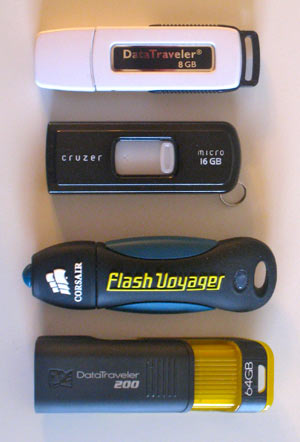
Flash DrivesSpeed tests can be calculated manually, but I used HD_Speed software to determine speeds of these common drives.

Size GB Read MB/s Write MB/s
Kingston DataTraveler I 8 17.8 7.8
SanDisk Cruzer Micro 16 24.9 5.2
Corsair Flash Voyager 16 28.8 6.9
Kingston DataTraveler 200 64 28.6 10.7

The speeds will vary depending on the size of the files transferred (block size). Larger files can be moved more efficiently than smaller files.

As you can see, the write speeds lag the read speeds. The latest generation of flash drives, such as the Kingston DataTraveler 200, are often significantly faster than older models.

Fast read speeds do not always translate into relatively fast write speeds, as demonstrated by the SanDisk Cruzer’s slower write speed than the Kingston DataTraveler I.

Speed should be more important to you when looking at larger drives since you’ll really notice it when moving more data. People didn’t tend to worry about the speed of 3.5 inch floppy drives when they only held 1.4 MB of data.

Counterfeits

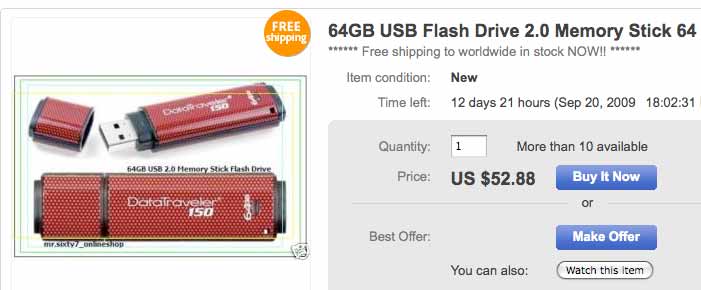
Another thing to watch for is counterfeits. Apparently there are several counterfeits of the Kingston DataTraveler 150 64GB often sold on eBay for around $50, less than half what they currently should cost. These drives still have 64GB of storage. They are just slow and prone to failure, leaving you without your data.

Counterfiet Flash Drive on eBay

AT&T and Sprint Mobile Signals Coming to DC Metro

According to The Washington Business Journal, AT&T  (meaning iPhones) and Sprint are now starting cell phone service in some DC Metro stations and will expand that coverage over the coming months.

Expanded Metro cell phone service starts Oct. 19

More cell phones will be working at some of the region’s busiest Metro stations starting Oct. 16, under an expanded wireless program first announced in May.

Verizon Wireless, Sprint Nextel, AT&T and T-Mobile began installing hardware at 20 select Metro stations over the weekend and will spend the next two months completing the initial installation.

Until now, Verizon Wireless has been the only carrier that worked in Metro stations under an agreement with Verizon Wireless’ predecessor, Bell Atlantic Mobile Systems, in 1993.

Sprint phones that roam to the Verizon network will also currently work.

The first stations to get the new multicarrier wireless network are: Ballston, Bethesda, Columbia Heights, Crystal City, Dupont Circle, Farragut North, Farragut West, Federal Center SW, Foggy Bottom-GWU, Friendship Heights, Gallery Place-Chinatown, Judiciary Square, L’Enfant Plaza, McPherson Square, Metro Center, Pentagon, Pentagon City, Rosslyn, Smithsonian and Union Station.

The carriers will install service in Metro’s remaining 27 stations by the end of 2010, although wireless phones won’t work in Metro tunnels until 2012.

The four carriers will operate and maintain the network, and are also building a second, separate wireless network for Metro’s use, including future plans for The Metro Channel, which will provide information, news and advertising on monitors in Metro stations and on trains.

Metro says the wireless contract will generate $25 million during its initial 15-year term and an additional $27 million during five, two-year renewals.

Verizon MiFi

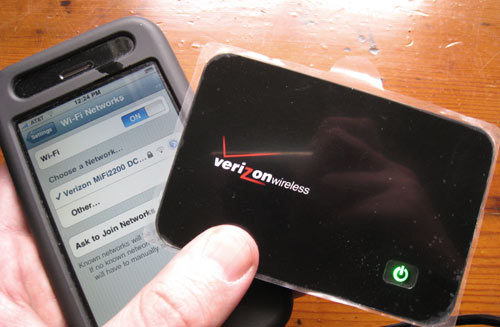
The Verizon MiFi is a new device that provides Internet from Verizon’s cellular data network. What makes it so special is that it is also a small router providing Internet for up to 5 people. It can run off of a battery and is the size of a deck of cards so you can easily carry it your pocket, making you a walking WiFi hotspot.

Verizon MiFi

Some people, fed up with the relatively spotty AT&T network, have even used the Verizon MiFi to use a better data netwok on their iPhone.

It costs $99 with a 2 year contract and a $60/month data plan.

This is a pretty good deal if you are a frequent traveler or even if you just are in a rural location that doesn’t get cable or DSL. It certainly is faster with better ping times than satellite internet.

Line for Apple Store in Arlington Selling iPhone 3GS

Because Apple and AT&T allowed people to pre-order for delivery, the line for the new iPhone 3GS at 7am today at the Clarendon Apple store in Arlington, Virginia, was about 10% of what we saw for the original iPhone and 3G.

In many ways, this was a less significant upgrade than the upgrade to the 3G. Key selling points of the 3GS include: faster speed (network and phone), video recording, better battery life, compass, and higher quality camera.

Several other upgrades are available to the previous iPhone through the recently released iPhone 3.0 OS. The new software includes cut and paste, photo messaging (available later when AT&T enables it), universal search, and a voice memo app.

I’ll probably buy the 3GS in several months when I qualify for the cheaper upgrade price.

iPhone 3GS line in front of Apple Store in Clarendon Arlington Virginia

Scroll to Top