

The End of America’s Electronics Pricing Advantage
The US is rapidly losing its position as a competitive market for consumer electronics. Recent tariffs have increased prices 15-45% on major categories while Canada now offers better value and Europe’s VAT-inclusive pricing has become competitive. The era of cheap American electronics—already a myth (the US ranked only #8 globally in 2016)—is definitively over.
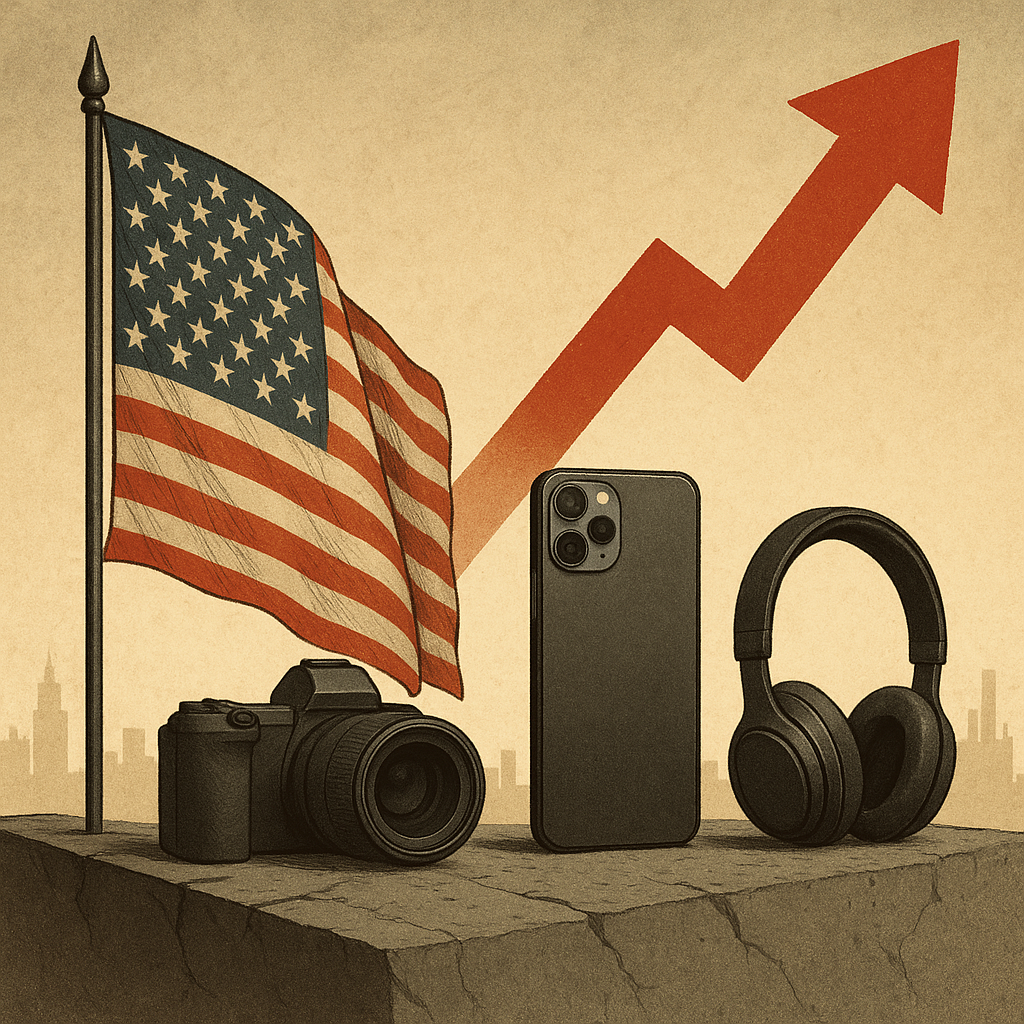
Analysis of late 2024/early 2025 pricing data reveals a fundamental shift. Escalating tariffs have overwhelmed traditional US tax advantages. Most surprisingly, manufacturing location provides no pricing benefit—Japanese cameras cost more in Tokyo, Chinese-made iPhones are pricier in Beijing. Shopping vacations abroad make no economic sense once you factor in travel costs, warranty limitations, and customs hassles.
Global pricing reveals US no longer competitive
Audio equipment: US becomes most expensive
The Audient iD24 audio interface (made in the UK) costs $549.99 in the US—the highest price globally. European retailers sell it for €323 ($351) including 19-20% VAT. After all taxes, California buyers pay $589 total while German buyers pay $351, a 40% premium for Americans. The UK manufacturing country offers it at £299 ($382 including VAT). Canada charges $437 USD equivalent before taxes.
Cameras: Canada leads, Japan costs more
Both the Fujifilm X100VI and Ricoh GR IV show Canada delivering the best value despite neither being manufactured there. The X100VI costs $1,577 in Canada (pre-tax) versus $1,600 US, $1,859 Japan, and $1,956 Europe. The GR IV costs $1,386 in Canada versus $1,497 US, $1,555 Japan, and $1,630 Europe.
The myth that electronics are cheaper in their country of manufacture is false—both cameras cost substantially more in Japan than North America despite Japanese manufacturing.
Smartphones: US-Japan tied for now, but tariffs threaten everything
The iPhone 16 Pro Max (256GB) ties at $1,199 in the US and Japan—globally cheapest. Canada follows at $1,218, while Europe pays $1,548 (29% more due to VAT). Hong Kong costs $1,312, and China—where iPhones are manufactured—charges $1,370.
The Samsung Galaxy S24 Ultra shows similar patterns: South Korea at $1,294, US at $1,300, Canada at $1,334, Europe at $1,548.
However, Trump administration tariffs threaten 26-40% smartphone price increases. Though temporarily exempted in April 2025, industry officials warn that $1,199 iPhone could jump to $1,700-2,300 when sector-specific electronics tariffs arrive.
US tariffs systematically eroding competitiveness
Multi-layered tariff structures implemented 2018-2025 create effective rates of 30-145% on electronics: Section 301 China tariffs (7.5-50%), Section 232 national security tariffs (15-50%), and 2025 reciprocal tariffs by country (10-46%). Country-specific rates include Japan 15%, South Korea 15%, Germany/France 15%, Vietnam 46%, and Mexico 25-35%—no manufacturing location offers tariff-free US access.
Camera manufacturers implemented 15-25% price increases in April-May 2025. The Consumer Technology Association projects 26% smartphone increases, 45% laptop increases, and 40% video game console increases under full tariff implementation. Average US households face $1,300 additional annual costs according to Tax Foundation estimates.
Supply chain relocation provides no escape—Apple’s production shift to India faces 26% tariffs there, while Samsung’s Vietnam manufacturing encounters 46% tariffs. Semiconductor industry relocation requires 5+ years minimum, with TSMC’s Arizona fabrication carrying 30% cost premiums versus Taiwan.
The myth of American electronics pricing dominance
The 2016 Linio Technology Price Index analyzing 71 countries ranked the US 8th globally—behind Kuwait, Saudi Arabia, Malaysia, Canada, UAE, Qatar, and Japan. Middle Eastern countries with near-zero VAT consistently beat American prices by 15-25%.
America’s past advantages—12-20 percentage point tax differential versus European VAT, large market scale, and aggressive big-box retail competition—have been overwhelmed by tariffs. Electronics prices declined 96% from 1997-2015, making electronics consistently deflationary. That trend reversed sharply starting 2018, with tariff-driven inflation representing a permanent structural change.
Middle Eastern markets maintain 15-25% advantages through near-zero VAT. Canada now undercuts US prices on cameras and smartphones by 7-15% pre-tax. Japan offers fierce retail competition but products typically cost 4-16% more than the US. Poland and Czech Republic emerged as the EU’s cheapest markets, with Czech prices at 64% of EU average.
Hong Kong’s decline as an electronics destination
Hong Kong’s reputation as a bargain electronics hub rests on outdated 1990s-2010s reality when zero taxes, proximity to Shenzhen manufacturing, and vibrant gray markets created 20-40% savings. The market has contracted: -0.7% annual growth 2017-2022 with projections of just 1.20% growth through 2029.
Global price convergence eliminated arbitrage. Manufacturers now enforce pricing globally, online marketplaces enable instant comparisons, and gray market crackdowns reduced parallel imports. Current pricing shows iPhone 16 Pro Max at $1,312—competitive but not cheapest (US and Japan beat it at $1,199). Hong Kong works only if visiting for other reasons, not as a dedicated electronics destination.
Shopping vacations are economically irrational
International shopping trips make no financial sense once you factor in flights, hotels, meals, and time costs. Add US Customs $800 exemption limits, warranty limitations (most manufacturers impose region-specific coverage—a gray-import device may have no US warranty at all), power/compatibility issues, impossible returns, and opportunity costs.
Shopping trips make sense only if already traveling for other reasons with no incremental costs. For typical consumer purchases, stay home and buy from authorized US dealers with warranties.
Gray market temptation and risks
Gray market goods—genuine products sold outside authorized channels—can offer 15-40% savings but carry serious risks. While generally legal in the US under first-sale doctrine, manufacturers track serial numbers, can blacklist devices, and may refuse all service including paid repairs.
A $1,000 laptop with no warranty is a potential $1,000 total loss from one defect—any “savings” evaporate with a single warranty claim. Additional risks: authentication challenges, region-specific firmware/software, incompatible LTE/5G bands, voltage differences, reduced resale value, no customer support or safety updates.
For typical consumers, the warranty risk alone makes gray market purchases imprudent.
What this means for American consumers
The evidence reveals a fundamental shift in global electronics pricing. American consumers face permanently higher electronics prices—the 15-45% increases already implemented represent structural changes, not temporary inflation. Even if future administrations reverse tariffs, supply chain costs and manufacturer pricing adaptations create lasting effects.
Key findings:
- Canada emerges as North America’s value leader, undercutting US prices 7-15% on cameras and remaining competitive on smartphones
- Europe’s VAT-inclusive pricing proves more competitive than assumed, with stable pricing absent tariff volatility
- Manufacturing location provides no advantage—Japanese cameras cost more in Tokyo, Chinese iPhones more in Beijing
- Hong Kong’s golden age ended as global pricing converged and gray markets disappeared
- Middle Eastern markets maintain genuine 15-25% advantages through near-zero taxation
Practical advice for Americans:
- Forget shopping vacations—travel costs, warranty risks, and hassles eliminate any savings
- Avoid gray market purchases—warranty loss can exceed any price savings
- Wait for domestic sales—Black Friday and Prime Day still offer 20-40% discounts
- Consider previous-generation products for significant savings
- Buy from authorized dealers and use credit card warranty extensions
The golden age of cheap imported electronics has ended. American exceptionalism in electronics pricing never existed to the degree assumed—the US ranked only 8th globally even in 2016. Recent tariff policies ensure it won’t improve. Americans will pay substantially higher prices for years regardless of whether reshoring goals succeed.
 Old computers and monitors have harmful materials that can seep into the ground water and air if thrown in your normal trash. The cadmium and mercury in displays can damage the nervous system. Computers also may contain lead (causing birth defects and learning disabilities) and CFCs (destroying the ozone layer).

 has decent prices, but is also just a good place to shop around for what you want. Between Amazon and Amazon’s third party sellers, their selection is huge and their reviews can help you figure out what is best for you.