Internet

Virgin Mobile MiFi 2200 Review

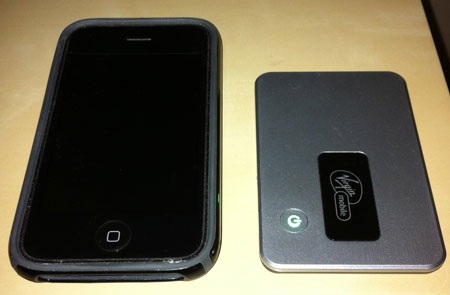
There are several MiFi devices out there these days but none as cheap as the one by Virgin Mobile.  A MiFi allows you to get on a cellular network via your devices WiFi.  Your laptop or iPad has WiFi but probably not built-in cellular network support.  This bridges that gap.  You can also use up to 5 devices thru the MiFi at one time so its more useful than a built-in connection like the high-end iPad.  This MiFi 2200 can be had from walmart.com for just $139.99 with no contract.  In comparison, the Verizon MiFi is $269.99.  The Verizon data plan is $60/month with a 5GB data cap while Virgin Mobile offers unlimited data for just $40/month.
Activation

The first thing you have to do is activate the MiFi.  This is actually different from paying for service.  Activation involves creating an account, getting some special IDs from Virgin Mobile, and entering them into the MiFi.  This is a simple guided process that you do by connecting to the MiFi via wireless and going to virginmobile.mifi in any browser.  One odd thing is that the MiFi will not connect to 3G (EVDO) until it is activated.  This means you have to go through the activation website via the older 1xRTT Sprint network which is only slightly faster than dial-up.  While annoying, you should only have to activate your MiFi once.  Once activated, you will then see it connect to 3G.

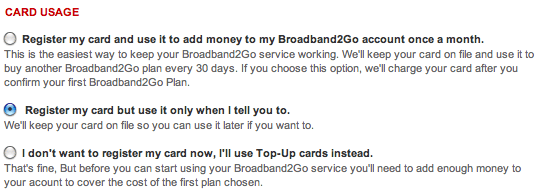
You can provide your billing info without actually starting your data plan.  You’ve got an option to have your plan auto-renew which is nice if you plan to use it always.  If you plan to use it only on occasional trips, there is also the option to only pay manually so when you sign up for a month of service, it will simply end at the end of the month.
Data Plans

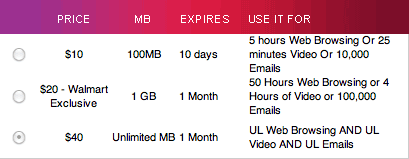
In addition to the $40/month plan that most will probably get, there is also a $10/month plan with 100MB cap.  That’s a great cheaper option if you just need to use the MiFi for a short period.  There’s one other secret extra special plan only available to people who buy their MiFi from walmart.  For $20/month, you get a 1GB cap.  That’s a nice additional plan option since that would likely cover most people for a week long trip.  This is plenty reason enough to purchase your Virgin Mobile MiFi from walmart.
Performance

Virgin Mobile is owned by Sprint so it uses Sprint’s cellular network.  When you are connected to Sprint 3G, you can expect typical downloads speeds of 300Kbps to 1000Kbps.  While testing, I typically had 2-4 bars of 3G and averaged about 450Kbps.  This is no where near as fast as most DSL or cable speeds but for the price and mobility, I think its terrific performance.  If you are not in a 3G area, the MiFi will fall back to the older 1xRTT network where the best speed you’ll likely see is 100Kbps and more typical is probably half that.  I recommend you check out sprint’s 3G coverage map before purchasing to be sure 3G is available in the areas you plan to use it.  The 1x speeds are fine if you’re desperate for any connection but it will be painful to use.  As long as you’ve got 3G, you’ll be happy with the performance, especially at just $40/month.  If my home internet ever went out, I’d be happy to use this as an alternate internet connection.  And since you can start your data plan through the device, you can do just that whenever you have to.

Battery Life

You can expect to get about 4 hours of continuous use from the MiFi.  It can be setup to automatically power down after X minutes of no usage.  This can be handy to save battery life but it is also easy to simply press the power button until the light goes out to save battery.

If you are looking for a little more battery life like me, I recommend an external usb battery like the Satechi Battery Extender Pack.  The built-in MiFi has a 1150 mAh battery.  This Satechi has a 4800 mAh battery.  That means it has enough extra juice to fully charge the MiFi over 4 times.  It can also be used to charge almost anything else powered by USB such as iPhones, iPads or most other cell phones.

Admin Options

This MiFi offers terrific admin controls.  You can change the wireless SSID, the wireless password or admin password.  You can even setup port filtering, port forwarding, and mac filters.  Once you’ve setup your config, you can even back it up to a computer in case you ever have to reset your MiFi and restore your setup.

Conclusion

The Virgin Mobile MiFi doesn’t offer the fastest speeds.  It doesn’t offer terrific battery life.  But it is an amazing price with terrific data plan options.  If you’re a price conscious shopper that wants connectivity for any of their many WiFi gadgets, this is the device for you.  I think road warriors or occasional travelers would be happy with this device.
LastPass Acquires Xmarks

My favorite cross-platform password manager, LastPass, just acquired my favorite cross-platform bookmark sync tool, Xmarks, thereby saving Xmarks from death. Back in September, Xmarks had announced that it would cease operations because it could not find a way to pay for the services it provided. With LastPass now taking over, they are moving to a “freemium” model, still offering Xmarks for free but having paid options as well. It’s great to see that Xmarks will stay around and to have two products that I trust and rely upon working together.

See the press release from Xmarks:

Today we’re excited to announce that Xmarks has been acquired by LastPass, makers of a leading cross-platform password manager. It’s a great opportunity that ensures the survival of Xmarks as the same service that you know and love.

In the last few years, we’ve attracted over 4.5 million users syncing more than 1 billion bookmarks across 5 million computers. Most importantly, we’ve provided a simple solution to help people easily access their bookmarks, wherever and whenever they needed to. We’ve had thousands of users tell us that Xmarks has become an integral part of their browsing experience. You can rest assured that LastPass will continue to build upon the service in the coming months.

We’re also committed to keeping Xmarks free while implementing a viable long-term plan. Xmarks is transitioning to a “freemium” business model, the same model that allowed LastPass to grow into a thriving, profitable business. The browser add-on and the vast majority of what users have enjoyed remains free. Users can then opt to purchase Xmarks Premium for $12 per year, which includes new enhanced features like Android and iPhone mobile phone apps, priority support, and more. The Xmarks and LastPass Premium offerings are also available bundled together at a reduced subscription rate of $20 per year. For those of you who pledged your financial support, you can make good on your pledge today and upgrade.

The restructuring of the Xmarks offerings will accelerate the introduction of new features and service improvements. The two services will continue to require separate downloads and will be administered through two distinct extensions and websites, although there are plans to integrate them in the future.

We believe the acquisition will prove to be a success because of the common mission shared by LastPass and Xmarks. Xmarks complements LastPass’ vision of secure, universal access to the information that gives you entry to your digital life. By joining LastPass, Xmarks will also be able to accelerate the introduction of new features and developments. As the ultimate cross-browser, cross-platform team, Xmarks and LastPass will work together to help more people simplify their digital lives and access their data from anywhere, at any time.

We’re excited to join forces with LastPass and be a part of a team that will continue to provide the best data-syncing tools out there! We hope you will support both of these great services through your business and your Premium subscription. For more information, please see the FAQs.

The Xmarks & LastPass Teams

Beware Phishing Scams

Wikipedia describes computer phishing scams:

Phishing is the criminally fraudulent process of attempting to acquire sensitive information such as usernames, passwords and credit card details by masquerading as a trustworthy entity in an electronic communication. Communications purporting to be from popular social web sites, auction sites, online payment processors or IT administrators are commonly used to lure the unsuspecting public. Phishing is typically carried out by e-mail or instant messaging, and it often directs users to enter details at a fake website whose look and feel are almost identical to the legitimate one. Phishing is an example of social engineering techniques used to fool users, and exploits the poor usability of current web security technologies.

Remember to avoid these scams by going directly to the site instead of clicking on a link sent to you in an email.

Here’s an email I just got. It’s either a classic phishing email, an attempt to infect your computer with a virus, or both.

From: Paypal <Services@support.com>

Subject: Your account has been temporarily limited

Date: November 12, 2010 1:26:37 PM EST

Dear customer,

Your account has been temporarily limited

Click here to resolve the problem

Thank You.

* Please do not reply to this email, as your reply will not be received. This is an automatic notification of new security messages.

Sincerely,

PayPal Security Department Team.

Stop the COICA Bill

COICA Bill

The Senate Judiciary Committee has before it a bill called “Combating Online Infringements and Counterfeits Act” or COICA that would allow censorship of the Internet.

This is a draconian law that one would expect from a dictatorship. It is supposed to stop copyright infringement, but it will only impact honset people. People who are really trying to steal content will have no difficulties getting over these technical hurdles.

If this passes, our Internet could theoretically become like China’s, with sites taken down without any due process. Only our rulers will be the commercial interests who are behind this bill.

From the EFF (Electronic Frontier Foundation):

The “Combating Online Infringements and Counterfeits Act” (COICA) is an Internet censorship bill which is rapidly making its way through the Senate. Although it is ostensibly focused on copyright infringement, an enormous amount of noninfringing content, including political and other speech, could disappear off the Web if it passes.

The main mechanism of the bill is to interfere with the Internet’s domain name system (DNS), which translates names like “www.eff.org” or “www.nytimes.com” into the IP addresses that computers use to communicate. The bill creates two blacklists of censored domains. The first is longer, and includes any sites where the DOJ decides that infringement is “central” to the purpose of the site. The bill gives ISPs and registrars strong legal incentives to censor the domains on that list. The Attorney General can also ask a court to put sites on a second, shorter blacklist; ISPs and registrars are required by law to censor those sites.

If this bill passes, the list of targets could conceivably include hosting websites such as Dropbox, MediaFire and Rapidshare; MP3 blogs and mashup/remix music sites like SoundCloud, MashupTown and Hype Machine ; and sites that discuss and make the controversial political and intellectual case for piracy, like pirate-party.us, p2pnet, InfoAnarchy, Slyck and ZeroPaid . Indeed, had this bill been passed five or ten years ago, YouTube might not exist today. In other words, the collateral damage from this legislation would be enormous. (Why would all these sites be targets?)

There are already laws and procedures in place for taking down sites that violate the law. This act would allow the Attorney General to censor sites even when no court has found they have infringed copyright or any other law.

How You Can Help

For more information, go to the EFF (Electronic Frontier Foundation) COICA page.

To help stop this, click “Take Action” on the right side of the EFF page to email your Senator.

Letter From Internet Engineers

Here’s a letter from Internet Engineers (basically the people who invented the Internet):

We, the undersigned, have played various parts in building a network called the Internet. We wrote and debugged the software; we defined the standards and protocols that talk over that network. Many of us invented parts of it. We’re just a little proud of the social and economic benefits that our project, the Internet, has brought with it.

We are writing to oppose the Committee’s proposed new Internet censorship and copyright bill. If enacted, this legislation will risk fragmenting the Internet’s global domain name system (DNS), create an environment of tremendous fear and uncertainty for technological innovation, and seriously harm the credibility of the United States in its role as a steward of key Internet infrastructure. In exchange for this, the bill will introduce censorship that will simultaneously be circumvented by deliberate infringers while hampering innocent parties’ ability to communicate.

All censorship schemes impact speech beyond the category they were intended to restrict, but this bill will be particularly egregious in that regard because it causes entire domains to vanish from the Web, not just infringing pages or files. Worse, an incredible range of useful, law-abiding sites can be blacklisted under this bill. These problems will be enough to ensure that alternative name-lookup infrastructures will come into widespread use, outside the control of US service providers but easily used by American citizens. Errors and divergences will appear between these new services and the current global DNS, and contradictory addresses will confuse browsers and frustrate the people using them. These problems will be widespread and will affect sites other than those blacklisted by the American government.

The US government has regularly claimed that it supports a free and open Internet, both domestically and abroad. We can’t have a free and open Internet without a global domain name system that sits above the political concerns and objectives of any one government or industry. To date, the leading role the US has played in this infrastructure has been fairly uncontroversial because America is seen as a trustworthy arbiter and a neutral bastion of free expression. If the US suddenly begins to use its central position in the DNS for censorship that advances its political and economic agenda, the consequences will be far-reaching and destructive.

Senators, we believe the Internet is too important and too valuable to be endangered in this way, and implore you to put this bill aside.

Scroll to Top