
Internet

How to test Ethernet cables and WiFi speeds

I recently had to diagnose poor ethernet speeds in a home in Arlington, VA. A person was getting 60 Mbps/sec, certainly not bad, but far less than the paid for 100 Mbps/sec. The problem was first diagnosed by going to speed test websites:

http://www.speedtest.net

https://www.speakeasy.net/speedtest/

This computer had FIOS, so I plugged a testing computer I had directly into the ONT (optical network terminal, where the fiber enters the house). From there I did get 100 Mbps/sec, so I knew the culprit was within the home network. I next tested the speeds from the home router. Those speeds, over both wifi and ethernet showed the slow speeds. So the main culprit appeared to be the cable connecting the ONT to the router.

To test the cable, I used iPerf, one of my favorite speed test tools. To buy a dedicated device that tests speeds can cost in the thousands of dollars from a company like Fluke. This is because you’re essentially buying a computer to do the tests. iPerf is a free tool that just uses your computers for the testing. You need to install iPerf on two computers and run one in client and one in server mode.

I used iPerf to test that suspect cable and got the following results:
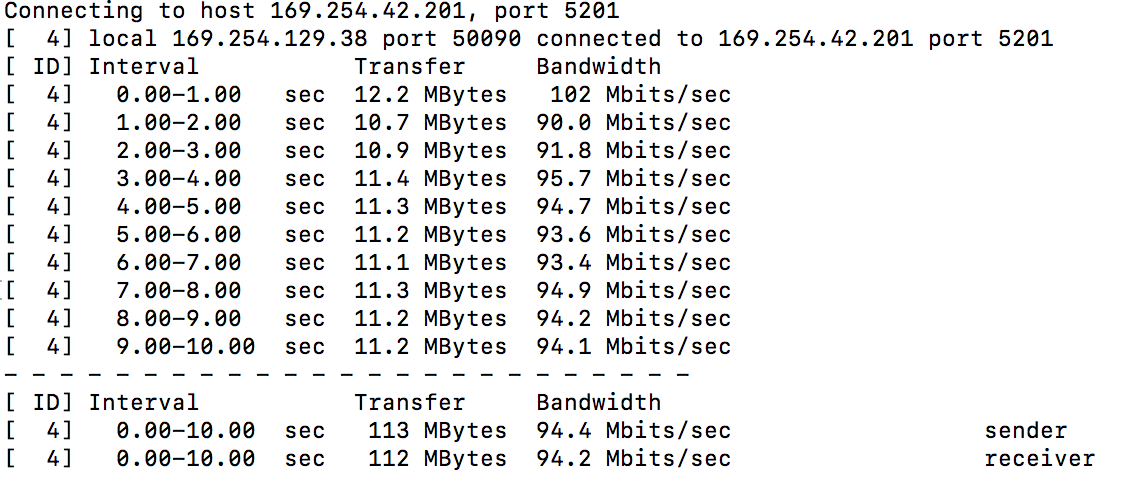
iPerf output showing 100 Mbits/sec speed capability of cableA good cable should get 10x this speed. So I re-terminated one of the cable ends to see if that would fix the cable. I couldn’t easily replace the cable since it took a difficult path through a wall. Happily fixing one end of the cable gave me the following iPerf results:
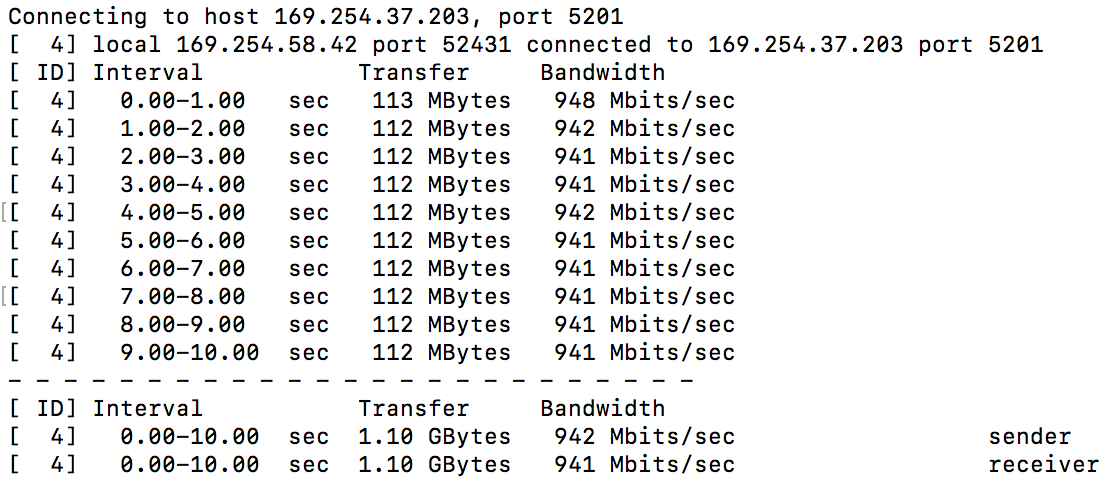
iPerf results showing gigabit speeds

This is what an operational cable’s results look like, showing gigabit speeds.

I next tested other ethernet jacks and the WiFi using iPerf and everything else checked out.

Unfortunately, this kind of testing isn’t widely performed. Most people don’t noticed degraded speeds in the first place. And if they do notice, they don’t know where to start to figure out the problem. Comcast and Verizon don’t normally perform this level of testing in my experience. Once the internet providers see good speeds getting to the house, they let the users deal with local network issues.

Ordering Internet Feels Like Buying A Car

Fargo's William H Macy
Fargo’s William H Macy

Have you ever haggled to get a lower price for a car? It’s a known practice. But most people don’t realize that it’s the same when ordering or renewing your internet service.

I had been paying for relatively slow but fast enough for me 15/15 Mbps Verizon FIOS service for $40/month. This was a two year deal which recently shot up to $75/month. So I called and asked what they could do. I even said that I wanted to cancel my service. Sometimes this gets you transferred to retention people who can offer you more. In this case, the representative said that he had to go off and talk to folks about what they could offer. Remember in Fargo when William H. Macey was selling a car to people and pretended to go talk to his boss? That’s what this felt like.

When the Verizon representative came back, he said that the best he could do was $50/month for 50/50 Mbps service. I said that I didn’t need that speed, but he said that it was the lowest speed currently offered by Verizon. I said that wasn’t good enough so he went to go to talk to people again. This time he came back and said that he could do it for $45/month.

Meanwhile, I was discussing the same topic with a Verizon online web chat person. This person said the best they could do was $40/month for 25/25 Mbps speed. So I hung up the phone and ordered through the web.

I don’t know if I got the best deal possible. I know someone who was recently given 30/30 Mbps for $45/month so it seems a little random. Both the phone and web person said that 30/30 wasn’t a current speed option. My guess is that the offers depend a little on who you happen to reach and what deals the sales people are told they can offer at the time.

Sadly, just like with buying a car, it’s the uninformed folks who can’t figure out the system and have to pay too much. These are often older folks who get tricked into buying an “internet security package” or are told that they need 50/50 Mbps speeds to watch Netflix. It’s no better than selling someone a pretend car undercoating.

Beeping FIOS battery

Has your FIOS or other internet box started beeping? The internet box that is usually just inside the house is called an Optical Network Terminal (ONT). (Note that the ONT plugs into another box with an antenna. This is the router.) The ONT has a Battery Backup Unit (BBU) since you need to have the ability to make 911 phone calls in the event of a power outage. But the rechargeable batteries usually just last 2-3 years.

Instead of having Verizon or your internet provider replace the battery, you can usually do so yourself if you’re comfortable opening the ONT and unplugging the battery. Replacement batteries are available at places like Amazon, BatteryMart, and Mighty Max Battery. They typically cost $30-50.

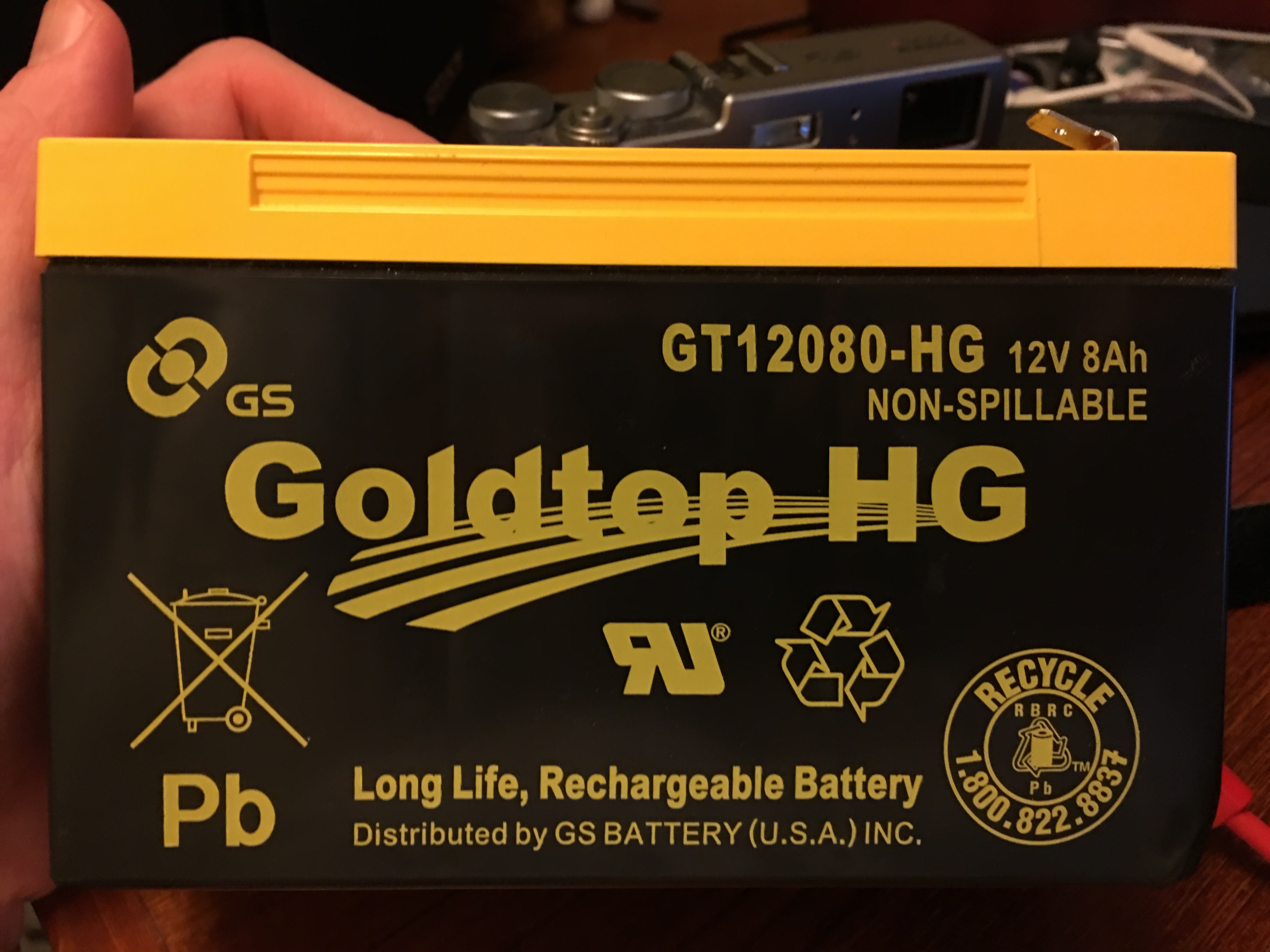
For my Verizon FIOS ONT, I had to purchase a battery that was comparable with the Goldtop HG GT12080-HG. The key things to look at are the terminal connection type, volts, and amps. My model has F2 terminals, 12 volts, and 8Ah.  You also want to make sure the dimensions fit or that the battery claims to be a direct replacement for your model.

Goldtop HG GT12080-HG Battery

Control Web Pop-Ups

Recently I helped someone with a computer that had out-of-control pop-ups appearing in the web browser. This typically happens when malicious software is installed or automatically added to a computer with other software.

To fix this problem, you need to set up your web browser and computer so that it’s settings don’t allow for these ads to show up. Here are some steps to follow:

  1. If you are on a PC, go to Add or Remove Programs (go to Start and type Add or)  and remove anything that was installed when this activity started. Typically this is software that sounds like Adware. It might have the word “Click” in it or it might be labeled as a download accelerator.
  2. If you are on a PC, turn on your Firewall (go to Start and type Firewall).
  3. In your browser, go into settings or options and change the homepage to something safe. Typically a hijacked browser will be sent to an ad page or search page where they make money on your searches. Instead, set your homepage to your favorite search engine (google, yahoo, etc) or a new page that you frequent.
  4. In your browser, go into Extensions and disable and remove any extensions that you do not use. This is where malicious programs will often operate to load up lots of ads.
  5. Run anti-virus software if you are on a PC. I like the free but very good Microsoft Security Essentials in you have Windows XP, Windows Vista, or Windows 7. Windows 8 should have built-in protection, as do Macs.

There are paid anti-virus programs such as Kapersky which will look for malware or adware that can cause this issue. Consider this only if you can’t control the issue on your own. Typically, this isn’t necessary if you take the above steps.

If your browser does not have these problems and the sites you visit just have a lot of pop-ups, consider adding an anti-pop-up extension to your browser. There are several good options.

If you are still having problems within your browser, you can also install another browser. On a PC today, I think Internet Explorer, Chrome, and Firefox are pretty good. In the past, IE was terrible, but they’ve improved a lot with some competition.


Scroll to Top